
Last updated: 11 October 2026

Screenshot from Rose’s video
“Becoming a ‘Chinese wife’: digital subjectivity, platform geopolitics, and the aesthetics of Ugandan influencer Rose Adikin’s media ecology”
Citation: Xiao, Mingyi. “Becoming a ‘Chinese wife’: digital subjectivity, platform geopolitics, and the aesthetics of Ugandan influencer Rose Adikin’s media ecology,” Cultural Studies, DOI: 10.1080/09502386.2026.2746056.
Abstract:
Digital media is the latest form of global communication, enabling political,
economic, and cultural interactions at the macro level while simultaneously
mediating these encounters into micro-level inter-user engagements. This
paper argues that digital media platforms register and reinforce disparities of
race, gender, and geopolitics within the ostensibly mundane practices of
everyday content production and consumption. This paper focuses on the
figure of the ‘digital subject’ that emerges on digital platforms – specifically,
influencers who exploit platform logics to construct an online persona while
subtly negotiating existing stereotypes to attract audiences and generate
profit. I examine the case of social media influencer Rose Mary Adikin, a
Ugandan woman who married a Chinese man and moved to Zhejiang, China.
Her videos construct an image of everyday life as a rural ‘Chinese wife’, yet
they also leverage the spectacular tension between her performance of
‘Chineseness’ and her racialised Black body, the asymmetrical gender
dynamics within her household, and her shifting personas across different
platforms. The gaps between Rose’s visible performance as a typical Chinese
rural housewife and the invisibilized aspects of her African origins are
constitutive of her digital subjectivity. Far from signalling a failure in selfrepresentation, these gaps generate a unique pleasure in witnessing a
mimicry that is ‘almost the same, but never fully Chinese’. The construction
of digital subjectivity in her videos, and the constitutive gaps embedded
within them, illuminate the complex mechanisms shaping Africa–China
dynamics in popular visual culture, shedding light on the paradoxical nature
of online self-representation, which simultaneously reflects and responds to
the desires of others.
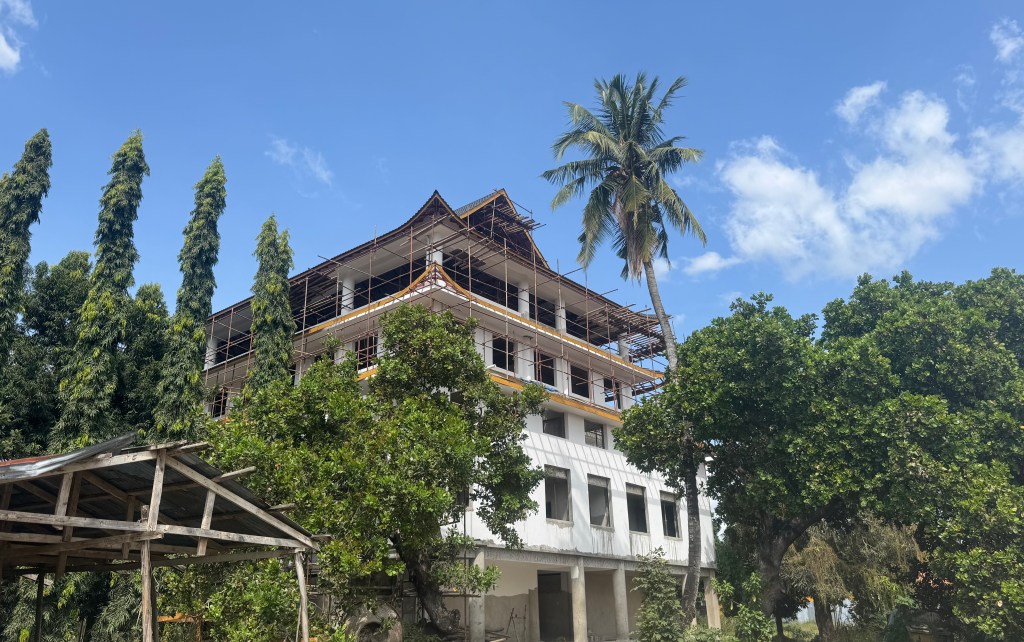
Photo by Mingyi Xiao
“Buddhism Reconfigured through Language: Reflections from a Chinese Temple in Tanzania”
Citation: Xiao, Mingyi. “Buddhism Reconfigured through Language: Reflections from a Chinese Temple in Tanzania.” Global China Pulse. https://globalchinapulse.net/buddhism-reconfigured-through-language-reflections-from-a-chinese-temple-in-tanzania/
Abstract:
This article is based on my fieldwork at Longquan Tanhua Temple, a Chinese Buddhist institution in Dar es Salaam, Tanzania. Focusing on two aspects of my visit—the Mandarin education offered to Tanzanian youth and the multilingual interpretation of Buddhist sermons for local audiences—I argue that language plays a constitutive role in reconfiguring Chinese Buddhism in the African context, specifically its strategies of outreach and its articulation of Buddhist teachings. The article extends existing scholarship on Chinese Buddhist institutions in Africa by foregrounding the entanglement of language and religion, revealing the multiple agencies and negotiations involved in everyday encounters.

Photo by Jamie Street on Unsplash
“Emptiness and Otherness: A Comparison Between the “Gift Debate” in French Postmodern Thought and Dāna-Pāramitā in Mahāyāna Buddhism”
Citation: Xiao, Mingyi. “Emptiness and Otherness: A Comparison Between the “Gift Debate” in French Postmodern Thought and Dāna-Pāramitā in Mahāyāna Buddhism.” Journal of Buddhist Ethics, Volume 31, 2024, pp. 369-95.
Abstract:
This article delves into the intersection of Western postmodern thought’s “gift debate,” rooted in Marcel Mauss’s work and continued by Jacques Derrida and Jean-Luc Marion, and Mahayana Buddhism’s practice of dona (almsgiving). Examining parallels, the paper identifies resonances in two dimensions. Firstly, in the realm of truth, the wisdom of “three-fold emptiness” in Madhyamaka Buddhism offers insights into the paradoxical nature of the gift, reconciling Derrida’s scarcity and Marion’s abundance perspectives. Secondly, ethically, the emphasis on the “other” in the gift prompts reflection on dona’s motives, deepening our understanding of self-other relationships in Buddhism. This exploration seeks to facilitate a comparative dialogue between postmodern thought and Mahayana Buddhism, unraveling philosophical, ethical, and religious dimensions within the act of giving.

